

Daily · November 29, 2026
Mortgage Rates This Week: What the Jobs Report and Fed Calendar Mean
Last updated:
Mortgage rates head into the first week of December near 7.2%, and Friday’s jobs report is the main event. Freddie Mac’s November 25 survey put the 30-year fixed at 7.21%. BLS publishes November payrolls on December 4, the last jobs report before the Fed’s December 8–9 meeting.
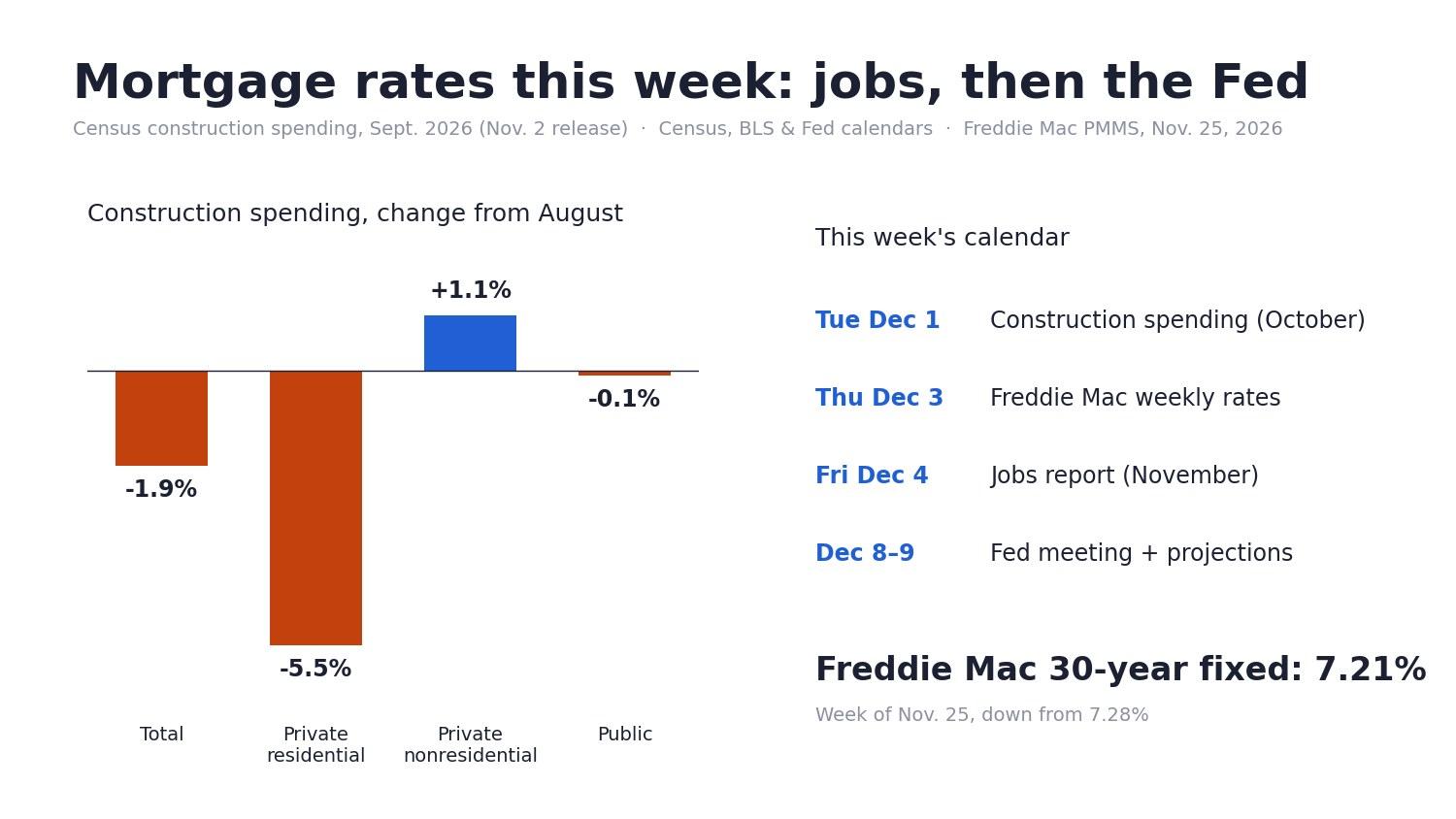
Construction figures are seasonally adjusted annual rates. Freddie Mac’s weekly rate is a survey average, not an offer.
Fast Home Loan Daily chart from Census Bureau construction spending (November 2, 2026 release), Census, BLS and Federal Reserve calendars, and Freddie Mac PMMS (November 25, 2026).
What could move mortgage rates this week?
Three scheduled releases matter most. The Census Bureau publishes October construction spending on Tuesday, December 1, at 10 a.m. ET. Freddie Mac’s weekly Primary Mortgage Market Survey is normally released on Thursdays at noon ET. The Bureau of Labor Statistics publishes the November Employment Situation on Friday, December 4, at 8:30 a.m. ET, the last jobs report before the Federal Reserve’s December 8–9 meeting. November consumer prices follow on December 10.
Rates start the week near 7.2%. Freddie Mac’s November 25 survey averaged 7.21% for the 30-year fixed and 6.54% for the 15-year, down from 7.28% and 6.66% a week earlier but above 6.23% and 5.51% a year ago. Mortgage News Daily’s November 27 index put the 30-year fixed at 7.29%, the 15-year at 6.93%, FHA at 6.97%, VA at 6.99% and jumbo at 7.40%.
The jobs report matters because it shapes expectations for the Fed and for Treasury yields, which fixed mortgage rates tend to follow. BLS reported on November 6 that payrolls rose 165,000 in October and unemployment was 4.1%, with August revised up to 186,000 and September to 60,000. Average hourly earnings were up 3.1% from a year earlier. On October 28 the Fed held its target range at 3.75% to 4%, and two of the 12 voters dissented in favor of a quarter-point increase.
If you have a loan in process, check when your rate lock expires relative to Friday morning and what an extension would cost. Trying to time one data release is a gamble, and the daily and weekly rate measures can move differently.
Lending conclusion: rates enter December near 7.2% on Freddie Mac’s weekly survey, and Friday’s jobs report is the biggest scheduled risk before the Fed meets. Know your lock dates before the data arrive.
Are banks making it harder to get a mortgage?
For most borrowers, no. The Federal Reserve’s October 2026 Senior Loan Officer Opinion Survey, published November 2, found residential mortgage standards basically unchanged on net for most loan categories. Banks reported easing standards for jumbo loans, both qualified-mortgage and non-QM, and tightening for subprime loans. Home equity line standards were basically unchanged.
Borrower demand is the weaker side. The same survey found weaker demand, on balance, across all residential real estate loan categories, with home equity line demand unchanged. It drew on responses from 61 domestic banks and 18 U.S. branches of foreign banks, collected by October 5.
Homebuilding spending is also soft. Census reported on November 2 that private residential construction ran at a seasonally adjusted annual rate of $848.8 billion in September, 5.5% below August’s revised $898.0 billion. Tuesday’s release will show whether that drop carried into October.
The jumbo easing matters near the loan-limit line. FHFA set the 2027 baseline conforming loan limit at $855,400, with a $1,283,100 ceiling in high-cost areas; loans above the local limit are jumbo. Mortgage News Daily’s jumbo index was 7.40% on November 27, against 7.29% for its conforming 30-year index, so compare both structures if your loan amount is close to the limit.
Residential conclusion: credit standards for most home loans have not tightened, and banks have eased on jumbo loans, but demand is weak and homebuilding spending fell in September. Shop terms with more than one lender.
Is commercial construction spending still growing?
Private nonresidential spending rose in September while the overall total fell. Census reported total construction spending at a seasonally adjusted annual rate of $2,186.1 billion, 1.9% below August and 2.7% below September 2025. Private nonresidential spending rose 1.1% to $790.6 billion, while public spending slipped 0.1% to $546.8 billion. Spending in the first nine months of 2026 was 2.9% below the same period of 2025.
Bank credit for commercial property tightened further. In the Fed’s October survey, domestic banks reported tighter standards, on net, for all three commercial real estate categories: construction and land development, nonfarm nonresidential, and multifamily. They also reported weaker demand in all three. U.S. branches of foreign banks reported tighter standards but stronger demand.
October construction spending comes out Tuesday, and Friday’s jobs report can move the Treasury yields that fixed-rate commercial loans are priced from. Mortgage News Daily’s page showed the 10-year Treasury near 4.94% after Friday’s session.
If you are seeking construction or acquisition financing, expect lenders to ask for more equity, reserves or recourse than a year ago, and request term sheets from more than one lender type. Underwrite debt service at current yields, not at an expected decline.
Commercial conclusion: private nonresidential spending is still rising, but banks are tightening on every commercial real estate category. Build extra time and equity into financing plans.
What does tighter multifamily lending mean for apartment owners?
It means refinancing may take more work. The Fed’s October survey found domestic banks tightened standards for multifamily loans on net and saw weaker demand for them. Tighter standards can show up as lower loan-to-value limits, higher debt-service coverage requirements or larger reserves, even before any change in the interest rate.
Several releases this month bear on apartment operations. BLS publishes November consumer prices, including shelter costs, on December 10. Census publishes November housing starts and permits, which include buildings with five or more units, on December 17, and November new-home sales on December 23.
Friday’s jobs report also matters at the property level. Payroll growth and unemployment affect renter household formation and collections, while the same report can move the Treasury yields used to price multifamily debt.
If a loan matures in the next 12 to 18 months, start lender conversations early, bring a current rent roll and trailing operating statements, and prepare for a smaller loan amount than the last refinance.
Property-management conclusion: banks are tightening on multifamily credit, so owners with near-term maturities should prepare documents and contingency equity now rather than wait for rates to fall.
What else should readers know?
Release dates, survey averages and bank surveys each answer a different question. Keep the publisher and date attached to every figure, and confirm your own loan terms before acting on any headline.
What could move mortgage rates this week?
Three scheduled releases matter most. The Census Bureau publishes October construction spending on Tuesday, December 1, at 10 a.m. ET. Freddie Mac’s weekly Primary Mortgage Market Survey is normally released on Thursdays at noon ET. The Bureau of Labor Statistics publishes the November Employment Situation on Friday, December 4, at 8:30 a.m. ET, the last jobs report before the Federal Reserve’s December 8–9 meeting. November consumer prices follow on December 10.
Are banks making it harder to get a mortgage?
For most borrowers, no. The Federal Reserve’s October 2026 Senior Loan Officer Opinion Survey, published November 2, found residential mortgage standards basically unchanged on net for most loan categories. Banks reported easing standards for jumbo loans, both qualified-mortgage and non-QM, and tightening for subprime loans. Home equity line standards were basically unchanged.
Is commercial construction spending still growing?
Private nonresidential spending rose in September while the overall total fell. Census reported total construction spending at a seasonally adjusted annual rate of $2,186.1 billion, 1.9% below August and 2.7% below September 2025. Private nonresidential spending rose 1.1% to $790.6 billion, while public spending slipped 0.1% to $546.8 billion. Spending in the first nine months of 2026 was 2.9% below the same period of 2025.
What does tighter multifamily lending mean for apartment owners?
It means refinancing may take more work. The Fed’s October survey found domestic banks tightened standards for multifamily loans on net and saw weaker demand for them. Tighter standards can show up as lower loan-to-value limits, higher debt-service coverage requirements or larger reserves, even before any change in the interest rate.
Sources: Freddie Mac PMMS (November 25, 2026 weekly averages; checked November 29); Mortgage News Daily rate index (November 27, 2026 daily index; checked November 29); BLS Employment Situation schedule (November 2026 data due December 4, 2026, 8:30 a.m. ET); BLS Employment Situation, October 2026 (Released November 6, 2026); BLS CPI release schedule (November 2026 data due December 10, 2026); FOMC meeting calendar (December 8–9, 2026 meeting with projections; checked November 29); FOMC statement, October 28, 2026 (Target range held at 3.75% to 4%); Fed Senior Loan Officer Opinion Survey (October 2026 survey, published November 2, 2026); Census construction spending (November 2, 2026 release; September 2026); Census economic indicator calendar (December 2026 release dates; checked November 29); FHFA 2027 conforming loan limit (November 24, 2026 release); CFPB rate lock guidance (Rate lock explainer; checked November 29).