

Daily · November 27, 2026
Mortgage Purchase Applications Jump 10% as Rates Dip
Last updated:
Mortgage purchase applications rose 10% in the week ending November 20, MBA reported November 25, the strongest weekly pace since September. Its average 30-year contract rate rose to 7.38%, but rates fell during the week. Purchase activity was still 16% below a year earlier, and MBA’s October payment index shows payments up 9.7% from 2025.
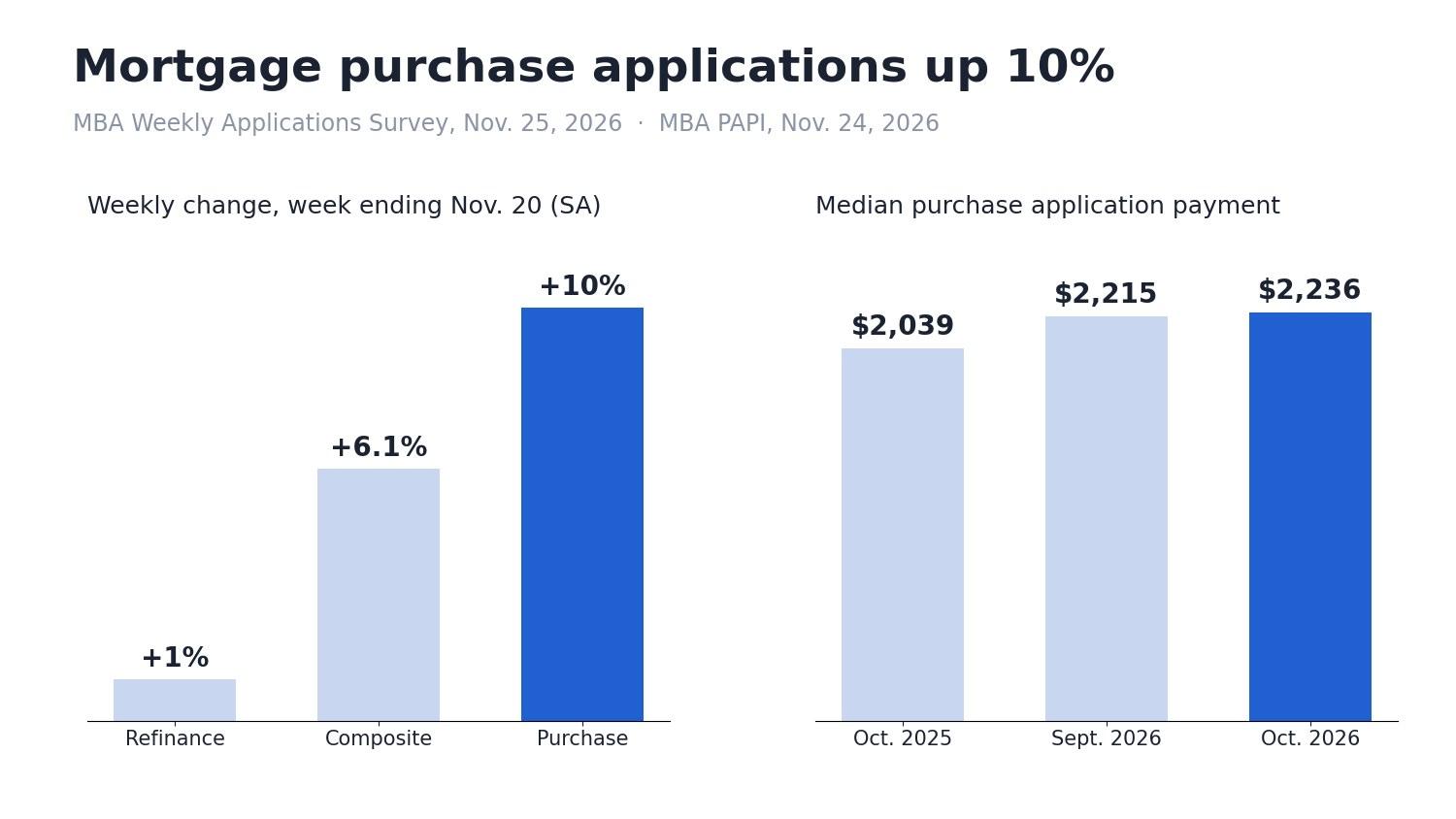
Weekly index changes are seasonally adjusted. Payments are MBA application medians, not offers.
Fast Home Loan Daily chart from MBA Weekly Applications Survey (November 25, 2026) and MBA PAPI (November 24, 2026) data.
Why did mortgage purchase applications rise last week?
Rates fell during the week, and buyers responded. MBA’s Weekly Applications Survey, released November 25 for the week ending November 20, showed its seasonally adjusted Purchase Index up 10% and the Market Composite Index up 6.1%. The Refinance Index rose 1% and was 51% lower than a year earlier. MBA said purchase applications reached their strongest weekly pace since September, while the unadjusted Purchase Index was still 16% below the same week a year ago.
The weekly average rate went the other way. MBA’s average contract rate for a 30-year fixed conforming loan ($832,750 or less) rose to 7.38% from 7.35%, with points at 0.77 including the origination fee. MBA said rates declined over the course of the week even though the weekly average was higher. Its 15-year average rose to 6.79% from 6.64%, the FHA rate eased to 7.05% and the jumbo rate eased to 7.29%.
More borrowers chose adjustable rates. The ARM share rose to 11.5% of applications, the highest in more than a year according to MBA, with the 5/1 ARM contract rate at 6.39%. An ARM’s lower starting rate is not the same as a lower lifetime cost; ask when and how often the rate can reset and what the caps allow.
The surveys measure different things and dates. Mortgage News Daily’s November 25 index read 7.26% for the 30-year fixed, 6.95% for FHA, 6.96% for VA and 7.40% for jumbo; Freddie Mac’s November 25 weekly average was 7.21%. Neither survey published a new reading on Thanksgiving, and none of these figures is an offer. Separately, FHFA said on November 24 that Fannie Mae and Freddie Mac will adopt the FICO 10T credit score on a timeline that mirrors their VantageScore 4.0 rollout. Ask a lender which credit score its pricing uses today.
Lending conclusion: buyers moved when rates dipped mid-week, and more chose ARMs for a lower starting payment. Compare fixed and adjustable Loan Estimates on the same amount and points before deciding.
Are monthly mortgage payments getting more affordable?
Slightly, by one measure. MBA’s Purchase Applications Payment Index, released November 24, fell 0.3% to 161.6 in October from 162.1 in September, which MBA describes as a small improvement in affordability. The median payment applied for still rose to $2,236 from $2,215, but earnings grew faster than that $21 increase.
Smaller loans did the work. The median purchase loan application amount fell to $315,424 in October from $324,022 in September, which MBA said offset a 37-basis-point rise in mortgage rates. Compared with a year earlier, the median payment was up 9.7% from $2,039 while earnings rose 1.6%, so the index was 8.0% higher, meaning affordability was weaker than in October 2025.
Government-backed borrowers are seeing the same pressure. The median payment for FHA applicants was $1,944 in October, up from $1,906 in September and $1,789 a year earlier, MBA reported. Builders’ customers paid more: the median payment in MBA’s builder survey rose to $2,375 from $2,307.
For a buyer, last week’s jump in applications reflects a better week for rates, not a turn in prices or payments. The Federal Reserve’s next scheduled policy meeting is December 8–9. Budget for the full monthly cost, including taxes, insurance and any mortgage insurance, rather than a single week’s headline rate.
Residential conclusion: payments are still higher than a year ago, and buyers are offsetting rates with smaller loans. Treat the weekly application jump as a response to a rate dip, not a market turn.
What do the 2027 multifamily caps mean for apartment financing?
The agency channel stays the same size. FHFA announced on November 23 that Fannie Mae and Freddie Mac can each buy up to $88 billion of multifamily loans in 2027, unchanged from 2026, for a combined $176 billion. At least 50% of each company’s multifamily business must be mission-driven affordable housing, and loans financing workforce housing are again excluded from the caps.
FHFA said it will raise the caps if needed and will not reduce them if the 2027 market turns out smaller than projected. MBA’s November 23 statement welcomed the unchanged caps and pointed to higher interest rates and significant loan maturities as forces that will shape multifamily lending in the year ahead.
Benchmarks have not moved since Wednesday. U.S. Treasury published no yield curve for November 26, Thanksgiving, so the latest closes remain November 25: 4.85% for the 10-year, 5.28% for the 20-year and 5.24% for the 30-year. Agency multifamily loans add a spread to their benchmark, so a sponsor facing a 2027 maturity should ask which index and spread a quote uses and how long it is held.
For owners with a maturity next year, an unchanged cap means agency capacity should be available, but not that terms will be easier. Underwrite refinance proceeds against current rates and actual operating income, and check whether the property could qualify under the workforce-housing or affordable categories.
Commercial conclusion: steady agency capacity supports apartment refinancing, while elevated benchmarks keep proceeds tight. Start maturity conversations early and stress-test the rate.
How do rents compare with mortgage payments for renewals?
Buying got a little costlier relative to renting. MBA’s November 24 report said its national mortgage payment to rent ratio rose to 1.44 at the end of the third quarter from 1.43 at the end of the second, meaning a typical purchase payment was 44% above median asking rent. MBA, citing Census, put the third-quarter median asking rent at $1,541, up from $1,531.
For lower-payment buyers the gap is smaller. MBA reported that the 25th-percentile purchase payment, $1,536 in October, was about equal to median asking rent, with that ratio holding at 0.99 in September. Some renters can buy at a similar monthly cost, but the down payment, closing costs and maintenance remain barriers.
Vacancy still argues for careful pricing. Census reported a national rental vacancy rate of 7.6% for the third quarter in its October 28 release, and BLS reported on November 10 that rent of primary residence rose 0.2% in October, seasonally adjusted.
When setting renewal terms, weigh what a resident would pay to move or buy against your own turnover cost. Use signed rents on comparable units, net of concessions, rather than national medians.
Property-management conclusion: owning still costs more than renting at the median, which supports retention, but higher vacancy limits how far renewals can rise. Price against local comparables.
What else should readers know?
An application count, a payment index and a rate survey each answer a different question. Keep the publisher and date attached to every figure, and confirm your own loan terms before acting on any headline.
Why did mortgage purchase applications rise last week?
Rates fell during the week, and buyers responded. MBA’s Weekly Applications Survey, released November 25 for the week ending November 20, showed its seasonally adjusted Purchase Index up 10% and the Market Composite Index up 6.1%. The Refinance Index rose 1% and was 51% lower than a year earlier. MBA said purchase applications reached their strongest weekly pace since September, while the unadjusted Purchase Index was still 16% below the same week a year ago.
Are monthly mortgage payments getting more affordable?
Slightly, by one measure. MBA’s Purchase Applications Payment Index, released November 24, fell 0.3% to 161.6 in October from 162.1 in September, which MBA describes as a small improvement in affordability. The median payment applied for still rose to $2,236 from $2,215, but earnings grew faster than that $21 increase.
What do the 2027 multifamily caps mean for apartment financing?
The agency channel stays the same size. FHFA announced on November 23 that Fannie Mae and Freddie Mac can each buy up to $88 billion of multifamily loans in 2027, unchanged from 2026, for a combined $176 billion. At least 50% of each company’s multifamily business must be mission-driven affordable housing, and loans financing workforce housing are again excluded from the caps.
How do rents compare with mortgage payments for renewals?
Buying got a little costlier relative to renting. MBA’s November 24 report said its national mortgage payment to rent ratio rose to 1.44 at the end of the third quarter from 1.43 at the end of the second, meaning a typical purchase payment was 44% above median asking rent. MBA, citing Census, put the third-quarter median asking rent at $1,541, up from $1,531.
Sources: MBA Weekly Applications Survey (November 25, 2026 release; week ending November 20); MBA Purchase Applications Payment Index (November 24, 2026 release; October 2026); FHFA 2027 multifamily loan purchase caps (November 23, 2026 release); MBA statement on 2027 multifamily caps (November 23, 2026 statement); FHFA FICO 10T approval (November 24, 2026 release); Freddie Mac PMMS (November 25, 2026 weekly averages; checked November 27); Mortgage News Daily rate index (November 25 daily index (latest); checked November 27); U.S. Treasury daily par yield curve (November 25 closes; no November 26 curve; checked November 27); FOMC meeting calendar (December 8–9, 2026 meeting; checked November 27); Census Housing Vacancy Survey (October 28, 2026 release; third quarter of 2026); BLS October CPI (November 10, 2026 release; rent monthly seasonally adjusted); CFPB compare multiple Loan Estimates (Comparison guidance; checked November 27).